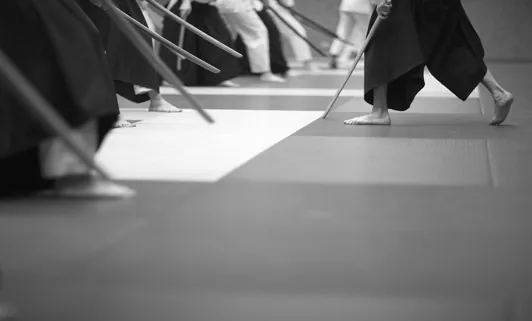
Kobudō (古武道) means “old martial way”. In mainland Japan the word describes the classical martial traditions of the samurai, such as swordsmanship. In the Karate world, it usually means Okinawan kobudō: the traditional weapons studied alongside empty-hand Karate.
Where it comes from
Okinawan kobudō developed over centuries in the Ryukyu Kingdom, alongside the empty-hand art that became Karate. A popular story says that Okinawan farmers and fishermen turned their everyday tools into weapons when ordinary weapons were restricted. Historians think the reality is more mixed, with much of the art developed and preserved by Okinawa’s warrior class, but many kobudō weapons do resemble farming and fishing tools.
In the 20th century, masters such as Taira Shinken worked to collect and preserve the old weapon kata, and today kobudō is practised around the world.
The main weapons
- Bō (棒) - a long wooden staff, about six feet (1.8 metres) long. It is used for striking, blocking and thrusting, and teaches control of distance.
- Sai (釵) - a metal truncheon with two curved side prongs. It is used for blocking, trapping and striking, and teaches angles and timing.
- Tonfa (トンファー) - a wooden baton with a side handle, which can spin and strike or guard the forearm.
- Nunchaku (ヌンチャク) - two short sticks joined by a cord, demanding speed, coordination and fluid movement.
- Kama (鎌) - a short sickle, usually trained with practice blades for safety.
- Eku (櫂) - an oar, used much like a staff.
Shorter staffs such as the jō are also widely practised in Japanese arts such as Jōdō.
How kobudō is trained
Like Karate, kobudō is learned through kihon (basic techniques), kata (set forms) and partner drills. Each weapon has its own kata, which build muscle memory, precision, timing and awareness of distance. The weapon becomes an extension of the body, so the same principles of stance, posture and hip movement apply as in empty-hand Karate.
Why practise it?
- Better Karate - weapons training sharpens distance, timing and body mechanics.
- Coordination - handling a weapon with both hands challenges the brain and body.
- Focus and discipline - weapons demand full attention and respect for safety.
- Connection with history - kobudō keeps alive the traditions Karate grew from.
Above all, kobudō shares Karate’s deeper aims: respect, discipline and self-improvement. Read more about Budō culture, or try learning a staff form as a way to train the brain.